


Pet light therapy has crossed the line from veterinary equipment to consumer product. Clinics have used photobiomodulation for post-operative recovery and chronic joint comfort for years; what changed recently is that owners can now buy a device for their own dog or cat for the price of a couple of vet visits. That shift has produced a market with a wide quality spread — and one recurring, under-reported problem: fur.
Key takeaways
- The pet light therapy device market was estimated at around $67.5 million in 2025 and is projected to reach roughly $148.5 million by 2033, a CAGR of about 10.6%.
- Fur is the defining engineering constraint. Coat density, length and pigment attenuate light before it reaches skin, which is why independent testing repeatedly finds budget devices underperforming their published specifications on thick-coated animals.
- Devices divide into handheld spot units, contact wraps and pads, and clinic laser systems — with very different dosing behaviour and price bands.
- Cats are not small dogs. Smaller anatomy, lower tolerance for restraint and shorter session tolerance all change the product design.
- SINOCO manufactures pet wraps, pads and handheld devices for dogs and cats under ISO 13485 and ISO 9001, with OEM and ODM programmes for pet brands, veterinary distributors and rehabilitation chains.

The Device Landscape in 2026
Three formats dominate, and they are not interchangeable.
| Format | Treated area per application | Typical price band | Best suited to |
|---|---|---|---|
| Handheld spot device | Roughly 5–20 cm² | $150–$600 | Wounds, joints, specific sites; owner or therapist operated |
| Contact wrap or pad | 100–600 cm² | $200–$800 | Hips, shoulders, spine, limbs; hands-free sessions |
| Clinic laser system | Operator-directed | $3,000–$15,000+ | Veterinary practices and rehabilitation centres |
Handheld devices
The Photizo Vetcare is the established reference: a handheld unit with pre-programmed 30-second dosing cycles, typically priced between about £350 and £450 in the pet market. Its strength is that the dose per press is fixed, which removes the guesswork that undermines owner-operated therapy. Its weaknesses, noted consistently in independent reviews, are a small treatment area, no optical comb to part the coat, and limited guidance on how many applications a given area needs — all of which make it harder to use well on a thick-coated dog than the simplicity of the interface suggests.
The LumaSoothe 2 occupies the budget position, using 635 nm red and 940 nm infrared at roughly £120 to £170. Independent testing has reported that its actual power output falls short of its advertised figures and that it struggles with fur penetration, particularly on thicker coats. That combination — a longer infrared wavelength with a thinner photobiomodulation evidence base, plus lower-than-stated output — illustrates precisely why buyers should not treat published specifications as verified.

Contact wraps and pads
Wraps address the two failure modes of handheld use at once. They hold emitters in contact with the animal — pressing through the coat rather than shining across it — and they remove the need for an owner to hold a device steady on a restless dog for ten minutes. For hips, shoulders, the lumbar spine and limbs, this is usually the more practical format, provided the wrap actually stays in place.
Clinic systems
Veterinary Class 3b and Class 4 laser systems are a distinct regulatory and safety category, requiring trained operators, eye protection and controlled-area procedures. They belong in practices. For a brand selling to owners, they are not a comparison point; for a brand selling to clinics, they are the competitive set.
| Brand | Format | Positioning |
|---|---|---|
| Photizo Vetcare | Handheld, pre-programmed dosing | The default owner-and-therapist device; small treatment area |
| LumaSoothe 2 | Handheld, 635 nm and 940 nm | Budget entry point; independent testing reports output below claims |
| MedcoVet Luma | Handheld with optical comb | Positioned around fur penetration and dosing guidance |
| B-Cure Vet | Handheld laser-class device | Portable clinic-adjacent positioning |
| Veterinary laser systems | Class 3b and 4 | Practice and rehabilitation centre equipment |
The Fur Problem, Properly Explained
Every meaningful engineering decision in this category traces back to the coat. Light must pass through hair before it reaches skin, and hair both scatters and absorbs it. The variables are not small:
- Coat density and length. A double-coated northern breed attenuates far more than a short-coated hound.
- Pigment. Dark coats absorb more visible light than light coats, and the effect is stronger in the red band than in near-infrared.
- Condition. Matted, dirty or wet coats behave differently again.
- Contact versus distance. A device held against parted fur loses far less than one held a few centimetres above the animal.
Three design responses distinguish a device built for animals from a human product with a paw on the box:
- Weight the near-infrared band. 850 nm penetrates better than 635–660 nm and is less affected by surface scatter, which is why serious pet devices lean on it. Note that 940 nm, common in budget devices because the emitters are cheap, is a different proposition — absorption by water rises and the photobiomodulation evidence base is thinner.
- Design for contact. An optical comb that parts the coat, or a wrap that presses emitters against skin, does more for delivered dose than raising the power rating.
- State protocols honestly. If a device’s output through a thick coat is a fraction of its bare-skin specification, session guidance should reflect that rather than quoting the bare-skin number.
This is also why published irradiance in the pet category should be read as an upper bound measured at the emitter, not as a dose delivered to tissue — the same measurement-standard gap that affects human devices, compounded by a variable no human device has to handle.

Cats Are Not Small Dogs
Products designed for dogs and rebadged for cats consistently disappoint, for reasons that are anatomical and behavioural rather than optical.
- Scale. A wrap sized for a labrador hip does not fit a cat, and an emitter layout mapped to canine anatomy puts light in the wrong places.
- Restraint tolerance. Many cats will not accept a ten-minute session in a fixed position. Devices intended for cats need to work in shorter applications or be genuinely comfortable to wear.
- Thermal sensitivity. Less body mass means surface heating matters more, and thermal cut-outs need to be set accordingly.
- Coat variety. From hairless to dense longhair, the attenuation range across cat breeds is wider proportionally than across dogs.
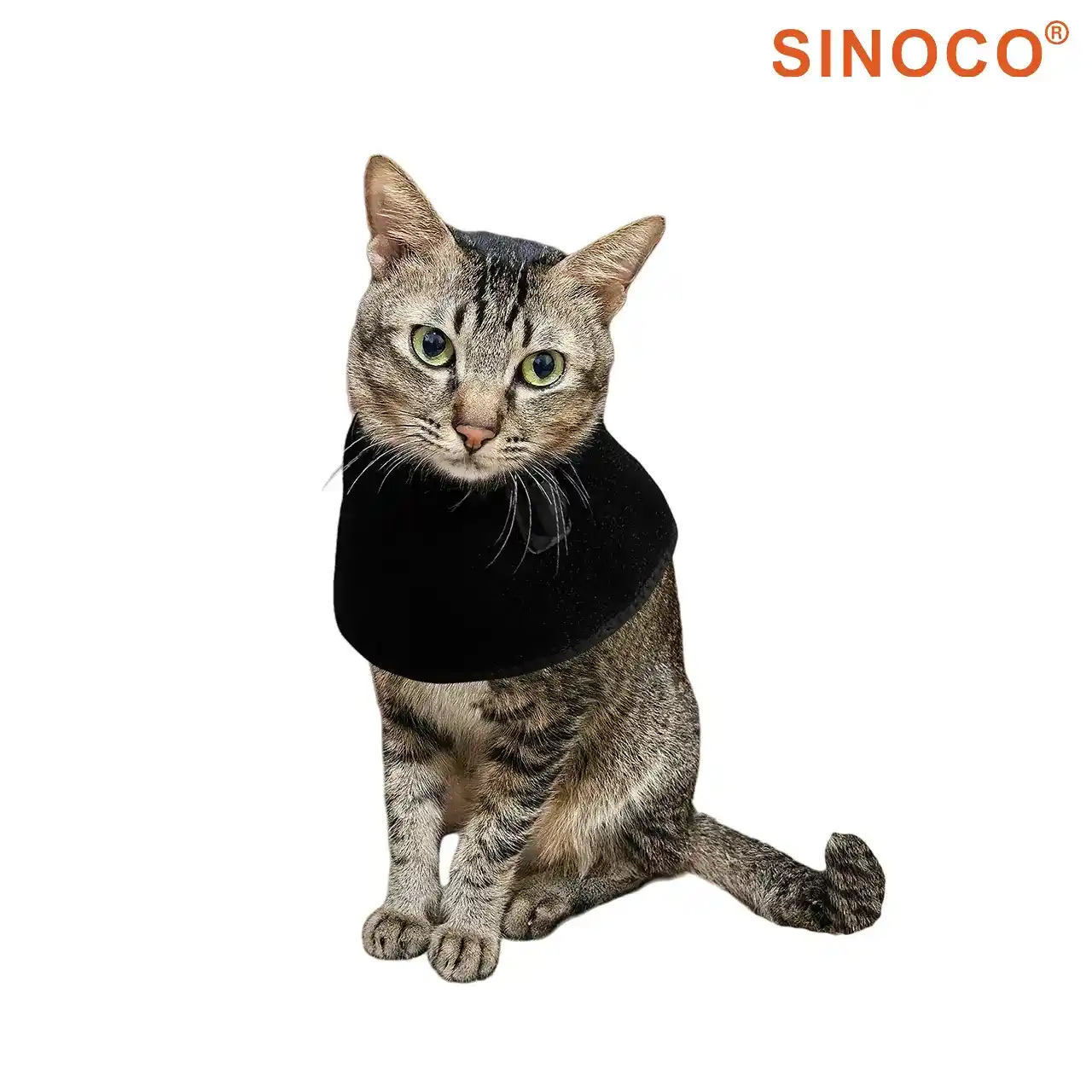
The practical consequence for a brand: a credible pet range needs at least a cat-specific size ladder and retention design, not a single universal product. SINOCO’s dog and cat light therapy range includes species-specific formats such as red light therapy wraps for cats and dog light therapy pads for exactly this reason.

Safety and Scope: What a Responsible Pet Brand Says
Light therapy for animals is a supportive modality. The devices sold to owners are not diagnostic tools, and a brand that blurs that line creates both a welfare problem and a liability. Manuals and marketing should be explicit about:
- Veterinary referral first. Sudden lameness, undiagnosed swelling, suspected fracture, suspected infection, and any mass or lump are veterinary matters before they are light therapy candidates.
- Contraindications. Do not treat over known or suspected tumours, over the eyes, or over the gravid uterus without veterinary direction.
- Eye exposure. Keep emitters away from the animal’s eyes, and note that Class 3b and 4 laser systems require eye protection for both operator and animal.
- Medication interactions. Photosensitising medications change the risk profile and warrant veterinary advice.
- Realistic expectations. Supportive comfort and recovery support, not cure claims.
From a regulatory standpoint, veterinary devices sit outside the human 510(k) pathway, but that is not an absence of obligation. Electrical safety, photobiological safety, battery safety and EMC still apply as product-safety requirements in every major market, and claims made about animal health are subject to advertising and consumer-protection rules.
| Standard | Scope | Why it matters |
|---|---|---|
| IEC 62368-1 or IEC 60601-1 | Electrical safety, depending on classification and market | Baseline safety for a mains- or battery-powered device |
| IEC 62471 | Photobiological safety of lamp systems | Risk group classification for the emitters used |
| IEC 62133 | Lithium cell and battery safety | Applies to every cordless handheld and wrap |
| FCC Part 15 and EMC | Electromagnetic compatibility | US and EU market access |
| ISO 10993 or equivalent materials file | Contact material safety | Skin and coat contact, plus chew exposure |
| ISO 13485 | Manufacturer quality management system | Evidence of design control at the factory |
| Per-lot optical test report | Wavelength, output, uniformity, temperature | The only defence against output drifting below spec after the first order |
Sourcing a Pet Light Therapy Range
What separates a real specification from a catalogue order
- Optical — wavelengths with tolerance, red-to-NIR weighting, emitter layout, active area, irradiance at contact, uniformity. Ask explicitly whether figures are bare-skin or through-coat.
- Species and size ladder — which breeds and body sizes the range covers, and the retention method for each.
- Durability — chew resistance on straps and cables, strain relief, IP rating, and washability of any fabric component.
- Thermal — surface temperature after a full session at maximum output, thermistor placement, cut-out threshold. Animals cannot tell you a device is too hot.
- Power — battery capacity, sessions per charge, charge protection, and behaviour in cold conditions.
- Protocols and documentation — session guidance grounded in the device’s real output, contraindications, and veterinary-referral language in the manual.
- Commercial — MOQ, tooling for each size, sample and production lead times, and packaging.
The modular platform argument
The economics of this category strongly favour a shared electronics platform. One controller, one battery and one charger driving a dog hip wrap, a dog leg wrap, a cat wrap and a handheld gives a brand a four-SKU range from a single engineering programme — lower tooling amortisation, simpler support, easier dealer stocking, and a coherent product family rather than four unrelated purchases.
For brands weighing whether to build on an existing platform or commission a bespoke design, our guide to choosing a veterinary red light therapy equipment manufacturer covers the evaluation process for clinics, rehabilitation centres and pet brands in more depth.
How SINOCO Builds Pet Light Therapy Products
SINOCO has been engaged in the research, development, production and sale of LED and red light therapy products for over 20 years, from a 10,000 m² Shenzhen facility certified to ISO 9001, ISO 13485, ISO 14001 and ISO 45001, with more than 30 national patents.
For the pet category specifically, that means wavelength weighting chosen for coat penetration rather than borrowed from a human product, emitter layouts mapped to canine and feline anatomy, species-specific size ladders, and construction that accounts for chewing, licking and washing. The dog and cat light therapy range spans wraps, pads and handheld devices, and shares an engineering platform with our equine range — useful for distributors who serve both small-animal and equine channels.
Every line runs through the same turnkey process: drawing and industrial design, material collection, incoming IQC, assembly with AOI inspection, outgoing QC and packing, then shipping and after-sales support.
Developing a pet light therapy range, or re-sourcing an existing one? Talk to the SINOCO team about coat-appropriate wavelength weighting, species size ladders and per-lot optical verification, or browse the dog and cat light therapy range.
Frequently Asked Questions
Does red light therapy work through a dog’s fur?
Only partially, and how much gets through varies widely. Coat density, length, pigment and condition all attenuate light before it reaches skin, and dark or double coats attenuate most. This is why well-designed pet devices weight near-infrared more heavily, use contact wraps or an optical comb to part the coat, and why published irradiance should be read as a bare-skin upper bound rather than a delivered dose.
What wavelengths are best for dogs and cats?
Red at 635 to 660 nm paired with near-infrared at 850 nm is the combination with the strongest evidence base, with the near-infrared band weighted more heavily to compensate for coat attenuation. Some budget devices use 940 nm because the emitters cost less, but water absorption rises at that wavelength and the photobiomodulation literature behind it is thinner.
Is red light therapy safe for pets?
LED photobiomodulation devices are generally regarded as low-risk when used as directed, but they are supportive rather than diagnostic. Avoid the eyes, do not treat over known or suspected tumours or the gravid uterus without veterinary direction, and consult a vet before use on animals taking photosensitising medication. Sudden lameness, undiagnosed swelling or any lump should be assessed by a veterinarian first.
Can I use a human red light therapy device on my dog?
It is not a good substitute. Human devices are designed for bare skin, so their wavelength weighting, emitter layout and protocols do not account for coat attenuation, and their form factors do not fit animal anatomy or stay in place on a moving animal. Purpose-built pet devices also set thermal cut-outs for animals that cannot tell you when something is too warm.
How is a cat device different from a dog device?
Cats need smaller sizing, emitter layouts mapped to feline anatomy, shorter or more comfortable sessions because tolerance for restraint is lower, and more conservative thermal limits because of lower body mass. A scaled-down dog wrap generally neither fits nor stays in position.
How big is the pet light therapy market?
The pet light therapy device market was estimated at around $67.5 million in 2025 and is projected to reach roughly $148.5 million by 2033, growing at approximately 10.6% CAGR. Growth is driven by home-use devices, rising spending on companion-animal health, and wider adoption of photobiomodulation in veterinary rehabilitation.
Do veterinary light therapy devices need FDA clearance?
Veterinary devices sit outside the human 510(k) pathway, but that is not an absence of regulation. Electrical safety, photobiological safety under IEC 62471, battery safety and EMC still apply as product-safety requirements in major markets, and animal-health claims remain subject to advertising and consumer-protection rules.
What MOQ should I expect for an OEM pet light therapy device?
An existing platform rebranded with your logo, colour and packaging typically starts in the low hundreds of units with samples in two to three weeks. A custom range with species-specific size ladders requires separate patterns and emitter maps per size, which raises minimums and extends lead times accordingly.
Conclusion
The pet light therapy category is growing quickly, and the quality spread within it is wide enough that independent testing regularly finds devices delivering a fraction of their advertised output. The brands that will hold shelf space are the ones that treat fur as a design constraint rather than a footnote — weighting near-infrared appropriately, designing for skin contact, sizing for the species, and publishing protocols that reflect what the device actually delivers through a coat.
For a brand owner, that is a sourcing decision more than a marketing one. Specify through-coat performance, require per-lot verification, and build the range on one modular platform. The result is a product line a veterinary distributor is willing to stock and an owner is willing to buy twice.
This article is written for brand, distribution and veterinary procurement teams. It is not veterinary advice. Any concern about an animal’s health should be assessed by a qualified veterinarian.