

The LED face mask went from niche beauty-device curiosity to a mainstream category in about four years. In 2026 the shelf is crowded with $350 to $500 consumer masks, a long tail of $60 marketplace listings, and a professional tier of PDT canopies sitting in clinics. For a brand owner deciding where to enter — or a clinic deciding what to buy — the useful question is not which mask is “best”, but which engineering choices separate the tiers.
Key takeaways
- The consumer market has settled into a flexible silicone camp (CurrentBody, Omnilux) and a rigid shell camp (Dr. Dennis Gross, Shark), and the geometry drives everything else — LED count, distance to skin, irradiance and session length.
- Wavelengths do different jobs: 415 nm blue for acne-causing bacteria, 633–660 nm red for skin and collagen-related endpoints, 830–850 nm near-infrared for deeper tissue, plus amber and green in multi-colour devices.
- FDA clearance is a claims question, not a quality badge. Leading consumer masks are FDA-cleared Class II devices; a mask sold on general wellness positioning may sit outside that pathway entirely.
- Professional PDT canopies are a different product class — far larger treated area, higher total optical power, adjustable head geometry, and clinic-grade duty cycles.
- SINOCO manufactures both tiers — silicone and rigid consumer masks, multi-function beauty devices, and adjustable PDT machines — under ISO 13485 and ISO 9001 in Shenzhen, with OEM, ODM and private-label programmes.

The Two Design Philosophies in Consumer LED Masks
Almost every consumer mask on the market in 2026 resolves to one of two mechanical approaches, and the choice cascades into every other specification.
Flexible silicone masks
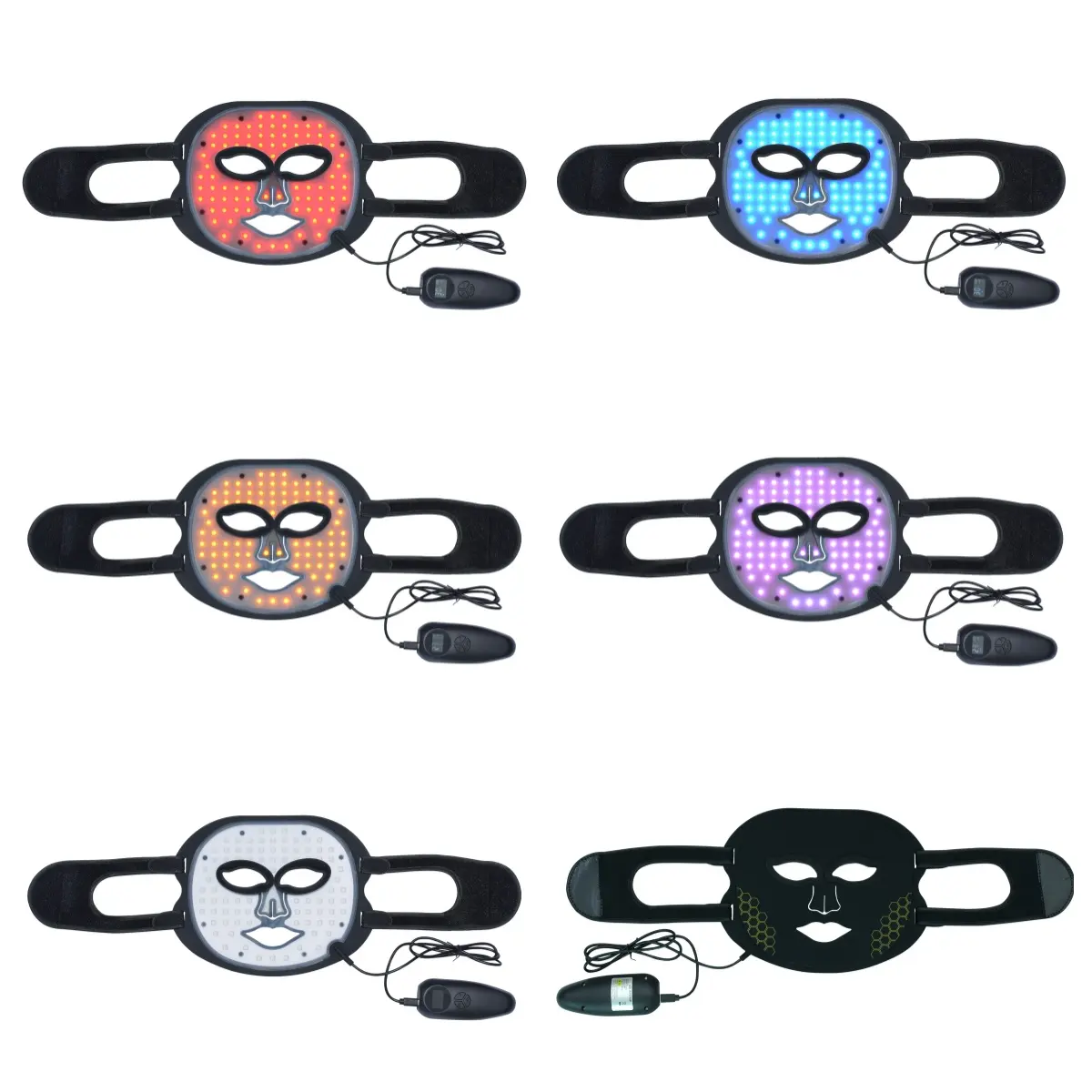
A soft medical-grade silicone shell conforms to the face, holding LEDs at near-zero distance across cheeks, forehead, nose and — on better designs — the jaw and neck. Because the emitters are close to the skin, each diode needs less optical power to deliver a useful irradiance, and coverage is more uniform across curved areas.
- Advantages — total facial coverage including curved and recessed areas, comfortable for supine use, lower per-diode power requirement, less perceived heat.
- Trade-offs — higher tooling and material cost, silicone can retain oils and needs proper cleaning validation, and flexible PCB reliability becomes a real engineering problem across thousands of flex cycles.
- Representative products — CurrentBody LED Mask Series 2 (around $469.99, three wavelengths, 236 emitters), Omnilux Contour Face (around $395, red and near-infrared only).
Rigid shell masks
A moulded polycarbonate or ABS shell held a centimetre or more off the skin. Distance costs irradiance, so rigid designs typically run fewer but more powerful diodes and often shorter, higher-intensity sessions.
- Advantages — lower tooling cost, easier thermal management, straightforward to clean, robust electronics, easier to integrate displays, cooling elements and accessories.
- Trade-offs — poorer conformity around the nose and jawline, uneven irradiance at the periphery, bulkier to store and travel with.
- Representative products — Dr. Dennis Gross DRx SpectraLite FaceWare Pro (around $455, red, near-infrared and blue, roughly 100 emitters, three-minute sessions), Shark CryoGlow (around $349.99, adds under-eye cooling pads and an LCD remote).
| Brand and model | Format | Light output | Approx. price | Distinguishing feature |
|---|---|---|---|---|
| CurrentBody LED Mask Series 2 | Flexible silicone | 3 wavelengths, 236 emitters | $469.99 | Full-face coverage, large installed base |
| Omnilux Contour Face | Flexible silicone | Red plus near-infrared | $395 | Lowest-cost mask from an established clinical brand |
| Dr. Dennis Gross DRx SpectraLite FaceWare Pro | Rigid shell | Red, near-infrared, blue; ~100 emitters | $455 | Three-minute session protocol |
| Shark CryoGlow | Rigid shell | Multi-wavelength | $349.99 | Under-eye cooling pads, LCD remote |
| CurrentBody Multi Light Therapy Mask | Flexible silicone | 6 wavelengths | Premium tier | Multi-colour programme range |
| Solawave Wrinkle Retreat Pro | Flexible | Red and near-infrared | Mid tier | Direct-to-consumer positioning |
Two patterns are worth noting from that table. First, the price band has compressed: the gap between the cheapest established brand and the most expensive is now under $150, which means differentiation has moved to session experience, coverage and brand rather than raw price. Second, emitter count is not a proxy for performance — a 236-emitter silicone mask and a 100-emitter rigid mask can deliver comparable doses because the rigid device compensates with per-diode power and shorter sessions.

Wavelengths: What Each Colour Is Actually For
Multi-colour masks are now the norm, and the marketing around them is frequently vaguer than the underlying science. The bands that have a meaningful literature behind them:
| Wavelength | Colour | Typical stated application | Penetration |
|---|---|---|---|
| 415 nm | Blue | Targets Cutibacterium acnes; acne-focused programmes | Surface only |
| 520–530 nm | Green | Pigmentation and tone-evenness programmes | Very shallow |
| 590 nm | Amber or yellow | Redness and sensitivity programmes | Shallow |
| 633 nm | Red | Most common red band in facial devices | 1–2 mm |
| 660 nm | Deep red | Collagen-related and wound-healing endpoints | 2–3 mm |
| 830 nm | Near-infrared | Deeper dermal and subdermal effects | 5 mm or more |
| 850 nm | Near-infrared | Deeper tissue, often paired with 660 nm | 5 mm or more |
Blue light deserves a specific caution. It is the band with the highest photobiological risk classification, and IEC 62471 exists precisely to assess it. A facial device emitting 415 nm needs proper eye protection design — opaque eye shields or a geometry that excludes the orbital region — and a risk group assessment in its technical file. This is one of the clearest dividing lines between a competently engineered mask and a marketplace listing.
FDA Clearance: What It Does and Does Not Tell You
Most established consumer masks — CurrentBody Series 2, Omnilux Contour Face, Shark CryoGlow among them — are marketed as FDA-cleared devices. Clearance here means a 510(k) premarket notification was accepted on the basis of substantial equivalence to an existing legally marketed predicate device. It is a meaningful signal, but it is widely misread.
- Cleared is not approved. FDA “approval” is a separate, far more demanding pathway used for high-risk devices. No consumer LED mask is FDA-approved.
- Clearance attaches to specific claims. The cleared indications for use define what the brand may say. A mask cleared for one indication is not cleared for everything the marketing implies.
- Clearance is not a performance ranking. Two cleared masks can differ substantially in irradiance, coverage and build quality.
- General wellness positioning may sit outside the pathway. The FDA’s photobiomodulation 510(k) guidance notes that light-emitting products intended only for general wellness use and presenting low risk may fall outside its scope.
For a brand owner, the operative decision comes first and the hardware second: decide what you intend to claim in each market, and let that determine whether you need a 510(k), a UKCA or CE route under the EU Medical Device Regulation, or a general wellness positioning with correspondingly restrained language.
| Standard | Scope | Relevance to facial devices |
|---|---|---|
| IEC 60601-1 | Electrical safety of medical electrical equipment | Applies to mains- and battery-powered masks |
| IEC 60601-2-57 | Non-laser light source equipment for therapeutic and cosmetic use | The governing particular standard for LED masks |
| IEC 62471 | Photobiological safety, including blue-light hazard | Essential for any device emitting 415 nm |
| ISO 10993 | Biocompatibility for skin contact | Required for silicone shells and face-contact surfaces |
| ISO 13485 | Medical device quality management system | Evidence of design control at the manufacturer |
| IEC 62133 | Lithium battery safety | Applies to cordless masks and controllers |
| EMC and FCC Part 15 | Electromagnetic compatibility | Market access requirement in the US and EU |
The Professional Tier: PDT Machines and Clinic Devices
Consumer masks and professional photodynamic therapy equipment are often discussed as if they were the same category at different price points. They are not. A clinic-grade PDT canopy differs in four structural ways:
- Treated area. A canopy covers the whole face, neck and décolletage in one position, and on articulated arms can be positioned over the back or limbs.
- Total optical power. Professional units are specified in tens to hundreds of watts of optical output, versus a few watts for a consumer mask.
- Geometry control. Height-adjustable, rotatable heads let an operator set a repeatable working distance — which is what makes dose reproducible between clients.
- Duty cycle and serviceability. Clinic equipment runs many sessions a day for years, so thermal design, driver headroom and field-replaceable modules matter far more than in a consumer product used three times a week.

For distributors and clinic chains, the buying criteria shift accordingly: serviceability, spare-part availability, calibration records, operator training materials and the ability to document a repeatable protocol across multiple sites. SINOCO’s adjustable photon PDT machine and rotatable, height-adjustable platforms are built for that use case, and our guide to choosing a PDT LED equipment manufacturer covers the evaluation process in more depth.
Private-Label and OEM Sourcing for Beauty Light Therapy
Where the cost actually sits
Brand owners consistently underestimate three line items and overestimate one.
- Underestimated: silicone tooling. A conforming full-face silicone shell with integrated eye protection is a multi-cavity tooling project, not a soft-goods purchase.
- Underestimated: photobiological and electrical testing. A full IEC 60601-1, 60601-2-57 and 62471 package on a multi-wavelength device is a substantial line item and takes weeks, not days.
- Underestimated: packaging and unboxing. In a $400 beauty device, presentation is part of the product, and premium packaging development runs in parallel with the device itself.
- Overestimated: the LEDs. Diodes are rarely the dominant cost. Driver quality, tooling, certification and packaging typically outweigh them.
The specification a serious buyer sends
- Optical — each wavelength with tolerance, emitter count per band, irradiance per band at the actual skin distance, uniformity across the treatment area.
- Programmes — session length per mode, intensity steps, auto-shutoff, whether the user can stack modes and what the firmware maximum is.
- Eye safety — shield design, orbital exclusion geometry, IEC 62471 risk group per band.
- Materials — silicone grade and biocompatibility file, surface finish, cleaning and disinfection instructions validated for the material.
- Electrical — battery chemistry and capacity, charge protection, sessions per charge at maximum output, standby draw.
- Mechanical — flex cycle target for silicone and flexible PCB, strap or headband design, drop and fatigue testing.
- Regulatory — which certificates exist today, which the factory will support, and in whose name the registration sits.
- Commercial — MOQ, tooling cost and ownership, sample and production lead times, exclusivity terms.
Typical programme parameters
In 2026, a private-label programme on an existing mask platform — your logo, colour, packaging and manual — can move in low hundreds of units with samples in two to three weeks. A custom silicone geometry with new tooling is a different order of commitment: expect tooling lead times of four to eight weeks on top of sampling, and plan certification in parallel rather than sequentially. Multi-function devices that combine LED with EMS or RF, such as our LED skin rejuvenation device with EMS, REJ and RF functions, add a further layer of electrical safety and applied-part testing.

How SINOCO Builds Beauty Light Therapy Products
SINOCO has been engaged in research, development, production and sales of LED and red light therapy products for over 20 years, from a 10,000 m² Shenzhen facility certified to ISO 9001, ISO 13485, ISO 14001 and ISO 45001, with more than 30 national patents from an in-house R&D team.
The beauty light therapy range spans the tiers described above: LED skin rejuvenation masks for the consumer market, multi-function devices combining photo-therapy with EMS and RF, and adjustable PDT machines for clinics and medical aesthetics chains. Because the same engineering team covers both consumer and professional platforms, a brand can start with a private-label mask and extend into a clinic device later without changing supplier.
Planning an LED mask or PDT device programme? Contact the SINOCO team for wavelength selection, eye-safety design and a market-specific compliance pathway, or explore the beauty light therapy range.
Frequently Asked Questions
Are flexible silicone LED masks better than rigid masks?
Neither is categorically better. Silicone masks hold emitters close to the skin and cover curved areas such as the nose and jawline more evenly, but cost more to tool and require careful flexible-PCB engineering. Rigid masks are cheaper to manufacture, easier to cool and clean, and compensate for the greater distance with higher per-diode output and shorter sessions.
What wavelengths should an LED face mask have?
Red at 633 nm or 660 nm is the core band for most facial devices, usually paired with near-infrared at 830 nm or 850 nm for deeper penetration. Blue at 415 nm is added for acne-focused programmes, and amber at around 590 nm or green at 520 to 530 nm appear in multi-colour devices. Every additional band adds drive complexity, cost and photobiological safety obligations.
Does FDA clearance mean an LED mask is proven to work?
No. FDA clearance means a 510(k) submission demonstrated substantial equivalence to an existing legally marketed device for specific indications. It is not the same as FDA approval, it does not rank performance between cleared devices, and it applies only to the claims in the cleared indications for use.
How is a professional PDT machine different from a consumer LED mask?
A PDT canopy treats the whole face, neck and décolletage in one position, delivers far higher total optical power, offers height and angle adjustment for a repeatable working distance, and is engineered for many sessions a day over years. A consumer mask is optimised for portability, comfort and a few short sessions a week.
Is blue light in an LED mask safe?
Blue light at 415 nm carries the highest photobiological risk classification of the bands used in facial devices, which is why IEC 62471 assessment matters. A properly engineered device includes opaque eye shields or a geometry that excludes the orbital region, and documents a risk group classification in its technical file. Devices without that documentation should be treated with caution.
What is the minimum order quantity for a private-label LED face mask?
On an existing manufacturer platform with your branding, colour and packaging, programmes commonly start in the low hundreds of units, with samples in two to three weeks. A custom silicone geometry requiring new tooling raises both the minimum quantity and the timeline, typically adding four to eight weeks for tooling alone.
How long should an LED face mask session be?
It depends on the device’s irradiance, not on a universal rule. Devices designed around higher per-diode output may specify sessions as short as three minutes, while lower-irradiance masks specify ten minutes or more to reach a comparable dose. Follow the manufacturer’s protocol rather than assuming longer is better — photobiomodulation follows a biphasic dose response.
Can one manufacturer supply both consumer masks and clinic PDT equipment?
Yes, and there are advantages to it. The wavelength science is shared, so a supplier covering both tiers can keep optical specifications consistent across a brand’s consumer and professional lines, reuse validated drivers and testing, and let a brand extend from a retail mask into clinic equipment without re-qualifying a new supplier.
Conclusion
The consumer LED mask market has matured to the point where price alone no longer differentiates, and the professional PDT tier is expanding alongside it. For brand owners, the meaningful decisions are made before any hardware is chosen: what you intend to claim, in which markets, and therefore which regulatory pathway and testing package the product must carry.
After that, the engineering questions are tractable — silicone or rigid, which bands, what irradiance at the real skin distance, and how the eye-safety design holds up under scrutiny. Get those right and the product survives contact with a market that is, finally, starting to ask harder questions.
This article is written for brand, product and clinic procurement teams. It is not medical or cosmetic advice, and it is not a treatment recommendation. Device claims must comply with the regulations of each market in which the product is sold.